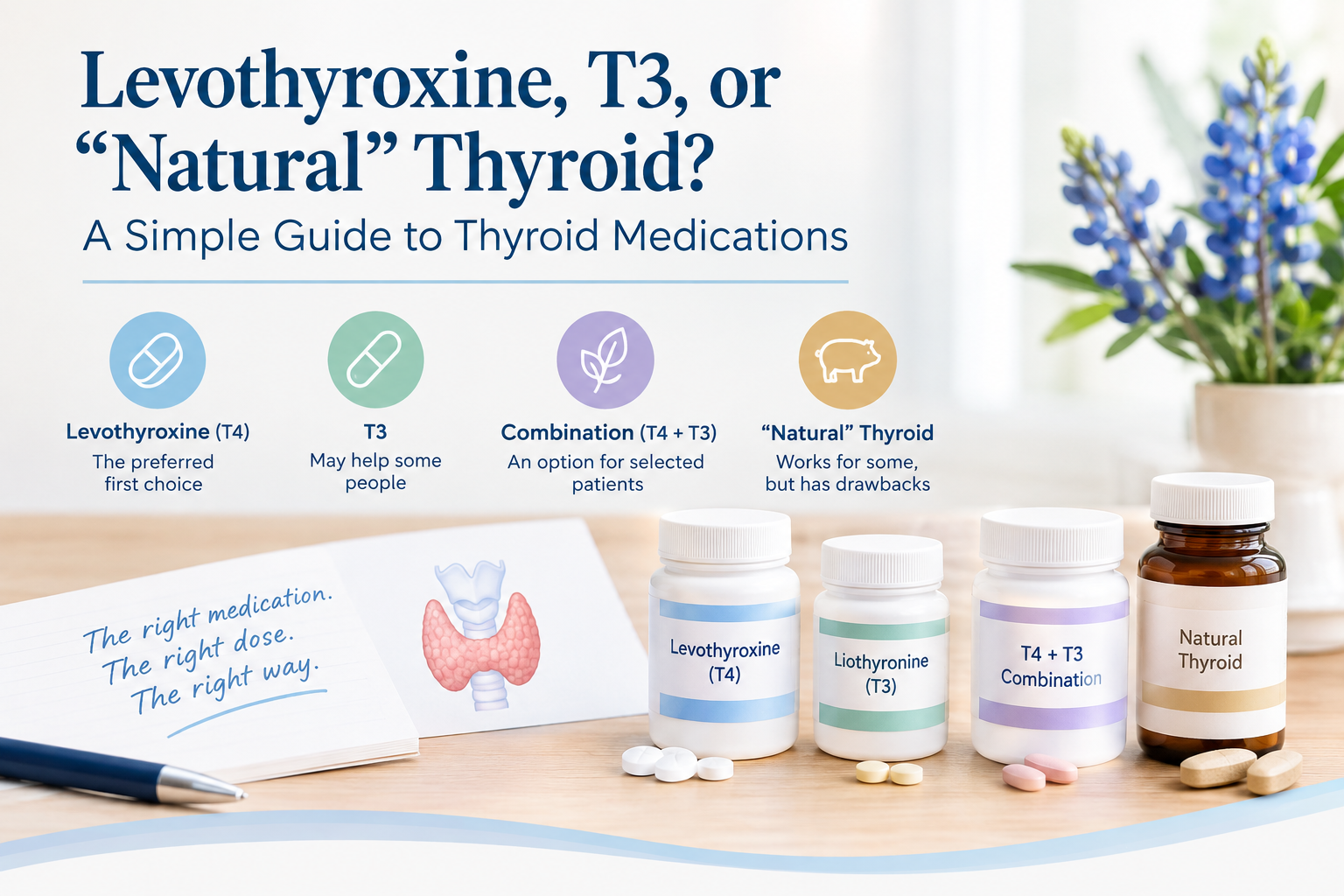
Levothyroxine is the most commonly prescribed thyroid medication in the United States. But it isn’t the only option out there. There’s also T3, combination therapy, and “natural” thyroid made from pig/cow glands. Each one has its place, and each has trade-offs. Here’s how they compare, what the experts recommend, and what I’ve learned about getting the best results from treatment.
The short version
- Levothyroxine (T4) is the best starting choice for almost everyone, and the preferred choice after thyroid cancer and during pregnancy.
- “Natural” thyroid works for some people, but it has real drawbacks and an uncertain future with the FDA.
- Adding T3 may help some people who still feel unwell on levothyroxine, but it isn’t for everyone.
- How you take your medicine matters as much as which one you take.
How thyroid hormone works
Your thyroid makes two main hormones:
- T4, which is the storage form
- T3, which is the active form
Your body turns T4 into T3 as needed. That’s why most people only need T4 replaced. The big question is whether some people need extra T3 too.
Levothyroxine (T4)
Synthroid, Levoxyl, Unithroid, Euthyrox, Tirosint, and generic Levothyroxine
This is what I start almost all of my patients on. The American Thyroid Association (ATA) recommends it as the first choice [1,2].
Why I like it:
- It lasts about a week in your body, so levels stay steady.
- Missing one dose isn’t a big deal.
- It comes in many strengths, so I can adjust your dose precisely.
- It’s inexpensive.
- It’s the only thyroid medicine proven safe in pregnancy [3] and the preferred medication after thyroid cancer.
Why it’s the preferred choice after thyroid cancer: After thyroid cancer surgery, levothyroxine does two jobs. It replaces the hormone your thyroid used to make, and it keeps TSH at a specific target. TSH can stimulate any remaining thyroid cancer cells to grow, so the target depends on your cancer risk, and for some patients it’s lower than normal [4]. Hitting that target takes steady levels and precise dosing, and levothyroxine/ T4 formulation gives us both. T3 and natural thyroid cause hormone levels to rise and fall through the day, which makes TSH harder to control and the labs harder to read and can potentially cause recurrence of thyroid cancer.
The downsides:
- Food, coffee, and many supplements block its absorption.
- Generic levothyroxine can come from different manufacturers, and your pharmacy may switch between them without telling you. Each one can vary slightly in how much hormone it delivers and how well it’s absorbed. For this reason, I often prefer brand-name levothyroxine, because the quality and dose stay the same from refill to refill. This matters most for my thyroid cancer patients, pregnant patients, and anyone whose levels are hard to keep stable [5]. If you take a generic, try to stay with the same manufacturer, and let us know if your pills ever look different.
- About 5 to 10 percent of people still have symptoms even with normal labs [6].
Liquid and gel forms: Some people don’t absorb tablets well. This includes people with celiac disease, people who have had gastric bypass surgery, and people who take acid-blocking medicines long-term. For them, liquid or gel capsule forms like Tirosint or Ermeza may work better [7]. They cost more, but they can make a big difference.
Liothyronine (T3)
Cytomel and generics
This is the active hormone in pill form. It works fast and wears off fast.
When it helps: In small doses added to levothyroxine for certain patients, or before some thyroid cancer scans.
The downsides:
- Levels spike a few hours after each dose. This can cause a racing heart, jitters, or trouble sleeping.
- It makes lab results harder to interpret.
The ATA does not recommend T3 by itself for treating hypothyroidism [1].
Combination T4 + T3
In 2021, the American, British, and European thyroid associations agreed that it’s reasonable to try combination therapy in people who still feel unwell on levothyroxine despite normal labs [6,8].
Here’s the honest part: large studies haven’t proven it works better than levothyroxine alone. Some patients do prefer it, though [6].
Before trying T3, I first check for other causes of fatigue, such as:
- Anemia
- Sleep apnea
- Low vitamin D or B12
- Depression or stress
If we do try it, I start with a low dose and watch closely. I don’t use it during pregnancy, in older adults, or in people with heart rhythm problems.
“Natural” Desiccated Thyroid
Armour Thyroid, NP Thyroid, and others
These are made from dried animal thyroid glands and contain both T4 and T3. The prescription products sold in U.S. pharmacies come from pigs (porcine).
The good: Some people feel better on it. In one study, about half of patients preferred it over levothyroxine, even though their symptoms improved about equally on both [9]. Another study found similar results across levothyroxine, natural thyroid, and combination therapy [10].
My concerns:
- Too much T3. Pig thyroid has about four times more T4 than T3. Human thyroid has about 14 times more. That can push your T3 too high.
- Less precise dosing. Doses are measured in “grains,” not exact amounts, and batches can vary.
- Not safe in pregnancy, and riskier for older adults and people with heart disease.
- Uncertain future. The FDA has never approved these products. In 2025, it announced plans to act on them. As of 2026, it is allowing them to stay on the market while manufacturers seek approval [11]. Supply and insurance coverage may change.
What about bovine (beef) thyroid? Some patients ask about thyroid made from cows, often because they avoid pork for religious or dietary reasons. Bovine thyroid isn’t sold as a prescription drug in U.S. pharmacies. It’s mostly sold online as a “glandular” supplement. These products aren’t standardized, so the amount of hormone can vary a lot from one bottle to the next, and the label may not tell you how much you’re actually getting [5,12].
The ATA does not recommend natural thyroid as a first choice [1].
Tips for Taking Your Thyroid Medicine
When a patient’s levels keep bouncing around, the cause is often how they take their medicine, not which medicine it is.
1. Be consistent. Take it the same way every day. Most people take it on an empty stomach, 30 to 60 minutes before breakfast [13]. Taking it at bedtime, at least 3 hours after eating, works too [14]. Choose what fits your routine.
2. Keep it separate. Wait at least 4 hours between your thyroid pill and:
- Calcium
- Iron
- Multivitamins
- Magnesium
- Antacids
Coffee and high-fiber foods can also lower absorption [1,7].
3. Tell us if your pill changes. If your pharmacy switches the brand or manufacturer, we’ll usually recheck your labs in 6 to 8 weeks.
4. Pause biotin before labs. Biotin is common in hair, skin, and nail supplements. It can make thyroid tests look wrong. Stop it 2 to 3 days before blood work.
5. Skip “thyroid support” supplements. Some have been found to contain real thyroid hormone [12].
Why the Right Dose Matters
Too much thyroid hormone over time can raise your risk of:
- An irregular heartbeat (atrial fibrillation)
- Bone loss and fractures, especially in older adults and women after menopause [15,16]
Too little can leave you tired, foggy, gaining weight, and with higher cholesterol. In pregnancy, it can affect the baby.
Your target isn’t the same as everyone else’s. I often aim for different levels in people over 70, in thyroid cancer survivors, and during pregnancy.
If you’re pregnant: Call your doctor right away. Most women need a 20 to 30 percent higher dose early in pregnancy [3].
The Bottom Line
For most people, levothyroxine taken the right way works well, is safe, and is affordable. If you still don’t feel like yourself even with normal labs, I believe you. There are good next steps, and they start with looking at the whole picture, not just switching pills.
I’m Dr. Neha Lalani, and I see patients at Bluebonnet Diabetes & Endocrinology in Lakeway, with telemedicine visits available across Texas. No referral needed. Call us at 512-387-4224 or request an appointment online.
This article is for general education and is not a substitute for personal medical advice. Please don’t change your thyroid medication without talking to your doctor.
References
- Jonklaas J, Bianco AC, Bauer AJ, et al. Guidelines for the treatment of hypothyroidism: prepared by the American Thyroid Association Task Force on Thyroid Hormone Replacement. Thyroid. 2014;24(12):1670–1751.
- Garber JR, Cobin RH, Gharib H, et al. Clinical practice guidelines for hypothyroidism in adults: cosponsored by the AACE and the ATA. Thyroid. 2012;22(12):1200–1235.
- Alexander EK, Pearce EN, Brent GA, et al. 2017 Guidelines of the American Thyroid Association for the diagnosis and management of thyroid disease during pregnancy and the postpartum. Thyroid. 2017;27(3):315–389.
- Haugen BR, Alexander EK, Bible KC, et al. 2015 American Thyroid Association management guidelines for adult patients with thyroid nodules and differentiated thyroid cancer. Thyroid. 2016;26(1):1–133.
- El Hage L, Makin V. How can I select the right thyroid hormone formulation for my patient with hypothyroidism?. Cleve Clin J Med. 2025;92(12):745–747.
- Jonklaas J, Bianco AC, Cappola AR, et al. Evidence-based use of levothyroxine/liothyronine combinations in treating hypothyroidism: a consensus document. Thyroid. 2021;31(2):156–182.
- Vita R, Saraceno G, Trimarchi F, Benvenga S. Switching levothyroxine from the tablet to the oral solution formulation corrects the impaired absorption of levothyroxine induced by proton-pump inhibitors. J Clin Endocrinol Metab. 2014;99(12):4481–4486.
- Wiersinga WM, Duntas L, Fadeyev V, et al. 2012 ETA guidelines: the use of L-T4 + L-T3 in the treatment of hypothyroidism. Eur Thyroid J. 2012;1(2):55–71.
- Hoang TD, Olsen CH, Mai VQ, et al. Desiccated thyroid extract compared with levothyroxine in the treatment of hypothyroidism: a randomized, double-blind, crossover study. J Clin Endocrinol Metab. 2013;98(5):1982–1990.
- Shakir MKM, Brooks DI, McAninch EA, et al. Comparative effectiveness of levothyroxine, desiccated thyroid extract, and levothyroxine+liothyronine in hypothyroidism. J Clin Endocrinol Metab. 2021;106(11):e4400–e4413.
- U.S. Food and Drug Administration. FDA’s actions to address unapproved thyroid medications. Updated 2026.
- Kang GY, Parks JR, Fileta B, et al. Thyroid hormone contamination in over-the-counter dietary supplements. Thyroid. 2013;23(10):1233–1237.
- Bach-Huynh TG, Nayak B, Loh J, et al. Timing of levothyroxine administration affects serum thyrotropin concentration. J Clin Endocrinol Metab. 2009;94(10):3905–3912.
- Bolk N, Visser TJ, Nijman J, et al. Effects of evening vs morning levothyroxine intake: a randomized double-blind crossover trial. Arch Intern Med. 2010;170(22):1996–2003.
- Flynn RW, Bonellie SR, Jung RT, et al. Serum thyroid-stimulating hormone concentration and morbidity from cardiovascular disease and fractures in patients on long-term thyroxine therapy. J Clin Endocrinol Metab. 2010;95(1):186–193.
- Abrahamsen B, Jørgensen HL, Laulund AS, et al. Low serum thyrotropin level and duration of suppression as a predictor of major osteoporotic fractures: the OPENTHYRO register cohort. J Bone Miner Res. 2014;29(10):2040–2050.