Every week in my clinic, someone sits down with a folder of lab results and says some version of the same thing: “My doctor says my thyroid is fine, but I don’t feel fine.” It’s a fair frustration. Thyroid lab reports are full of abbreviations that nobody explains, and the internet is full of confident answers that range from partly true to flat wrong.
So let’s go through thyroid labs properly: what each test means, which ones matter, and what to do when the numbers and your symptoms don’t agree.
First, How the System Works
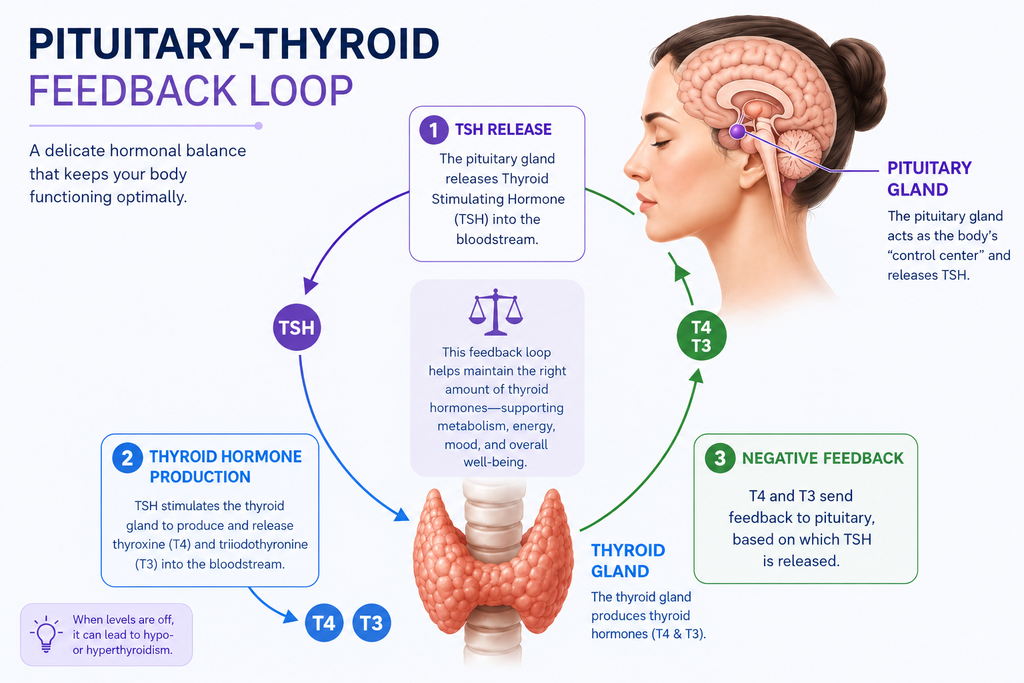
What is TSH? Your thyroid doesn’t decide on its own how much hormone to make. The pituitary gland in your brain monitors hormone levels and sends out TSH (thyroid stimulating hormone) as its instruction signal. When thyroid hormone runs low, TSH rises – the pituitary is essentially raising its voice. When hormone levels are high, TSH drops. That feedback loop is why a single TSH value tells us so much.
What Each Test in “Thyroid Labs” Actually Measures
- TSH: The best first test, per the American Thyroid Association (ATA). High TSH usually means an underactive thyroid (hypothyroidism). Low TSH usually means an overactive one (hyperthyroidism). In most healthy people, a normal TSH means the system is working.
- Total T4: Measures thyroxine, the main hormone your thyroid makes. But most T4 in your blood is bound to proteins and inactive, so total T4 can be skewed by pregnancy, estrogen, and other medications (conditions that alter the binding protein levels).
- Free T4: Measures only the unbound hormone that your body can actually use. Paired with TSH, this is the important lab for diagnosing thyroid dysfunction.
- Total T3 and Free T3: T3 is the active thyroid hormone, mostly converted from T4 out in your tissues. T3 testing is helpful in hyperthyroidism, where levels run high. In hypothyroidism it adds little value because T3 is often the last value to drop, and the ATA notes it isn’t much help in making that diagnosis.
- Thyroid peroxidase (TPO) antibodies : Not a function test, but worth mentioning: these identify autoimmune (Hashimoto’s) thyroid disease and can turn positive years before TSH becomes abnormal.
- TSH Receptor (TRAb) antibodies : Not a function test, but it shows that there are autoantibodies that are attached to TSH receptors on the thyroid gland. It does not say whether these autoantibodies are “blocking”, “stimulating” or “neutral” for thyroid function.
- Thyroid stimulating Immunoglobulin (TSI): Not a function test, but it shows that there are autoantibodies for TSH receptors on the thyroid gland that could stimulate thyroid function and cause hyperthyroidism (Graves’ disease).
- Thyroglobulin (Tg): Not a function test, it is a protein that is made by the thyroid gland. It is useful to check this labs in patients who had their thyroid surgically removed for thyroid cancer, as an early indicator of recurrence.
- Thyroglobulin Antibodies (TgAb): Not a function test. These are autoantibodies that attach to Thyroglobulin protein that is made by the thyroid gland. This is one of the antibodies that can be elevated in Hashimoto’s disease. For thyroid cancer patients, these antibodies interfere with the measurement of Thyroglobulin (tumor marker for thyroid cancer recurrence), that is why it is always checked along with Thyroglobulin level.
The Reverse T3 Problem
Reverse T3 gets heavy promotion online as a test for “hidden hypothyroidism.” Here’s what it actually is: an inactive byproduct your body makes when clearing T4. It rises with fasting, illness, stress, and certain medications. In other words, it reflects what’s happening elsewhere in the body, not how your thyroid is doing.
Neither the ATA nor the joint AACE/ATA clinical practice guidelines include reverse T3 in the diagnosis or management of hypothyroidism. The result doesn’t change treatment. What worries me is what often happens next: a “high rT3” becomes the justification for starting or escalating thyroid hormone in someone who doesn’t need it, and it is not harmless.
The Real Dangers of Overtreatment
Taking more thyroid hormone than your body needs, whether from an rT3-driven protocol, desiccated thyroid dosed by symptoms, or simply a levothyroxine dose that was never re-checked – creates a state of iatrogenic hyperthyroidism. Studies suggest roughly one in five patients on thyroid hormone is overtreated at any given time. The documented risks:
- Atrial fibrillation: In the Framingham cohort, adults over 60 with a suppressed TSH (which can be caused by overtreatment) had roughly a threefold higher risk of developing atrial fibrillation over 10 years (Sawin et al., NEJM 1994).
- Stroke and cardiovascular events: A large Scottish cohort of over 17,000 patients on levothyroxine found increased cardiovascular disease and arrhythmias in those with suppressed TSH (Flynn et al., JCEM 2010). Veterans Health Administration data likewise linked overtreatment to higher rates of atrial fibrillation and stroke (Medscape summary).
- Bone loss and fractures: Excess thyroid hormone accelerates bone turnover. The Flynn study found roughly double the fracture risk with suppressed TSH, and the ATA has warned about fracture risk from excessive doses in older adults, particularly postmenopausal women.
- Other effects: Palpitations, anxiety, tremor, insomnia, muscle loss. A 2023 review in JCEM ties persistently suppressed TSH to this full range of cardiac and skeletal harm.
The pattern matters: the treatments sold as fixing “what your doctor missed” carry real cardiac and bone risk while treating a condition you may not have.
So Why Do You Still Feel Hypothyroid With Normal Thyroid Labs?
Your symptoms are real. The question is what’s causing them, and there are several legitimate answers:
- These symptoms have many causes. Fatigue, weight gain, hair loss, cold intolerance, and brain fog are not specific to the thyroid. Iron deficiency (even with a normal blood count), low B12 or vitamin D, sleep apnea, depression, perimenopause, and insulin resistance all mimic hypothyroidism well. So do beta-blockers, antihistamines, and some antidepressants.
- Your personal setpoint. The TSH “normal range” comes from population data. A TSH of 3.8 is technically normal, but if your lifelong baseline was 1.0, you might feel the difference. Trends over time matter more than one number.
- Early Hashimoto’s. TPO antibodies can be positive years before TSH shifts, and some patients report symptoms in that window.
- You’re on levothyroxine and still not well. This describes 10-15% of treated patients. Differences in how individuals convert T4 to T3 may explain some cases, and it’s an active research area – one where careful, individualized adjustment matters far more than a bigger dose.
- Lab interference. Biotin supplements (>5000mcg per day, as found in some hair, skin, nail vitamins) distort thyroid assays. Taking levothyroxine with coffee, calcium, or iron blocks absorption and makes results bounce around.
Where an Endocrinologist Fits In
The incorrect responses to “normal labs, persistent symptoms” are dismissal on one side and unnecessary thyroid hormone on the other. The correct response is a systematic workup: the full thyroid picture in context, screening for the common mimics above, a hard look at medications and supplements, and if you’re already on treatment, confirming your dose, formulation, and timing are actually optimized. That’s the work of a specialist, and it’s how you avoid being undertreated or exposed to the risks above.
If this sounds like your situation, we’d be glad to help you sort it out. I’m Dr. Neha Lalani, and I see patients at Bluebonnet Diabetes & Endocrinology in Lakeway, with telemedicine visits available across Texas. No referral needed. Call us at 512-387-4224 or request an appointment online.
This article is educational and not a substitute for individualized medical advice.
References
- American Thyroid Association. Thyroid Function Tests
- American Thyroid Association. Hypothyroidism (Underactive Thyroid)
- Garber JR, et al. Clinical Practice Guidelines for Hypothyroidism in Adults: Cosponsored by AACE and ATA. Endocrine Practice, 2012.
- Sawin CT, et al. Low serum thyrotropin concentrations as a risk factor for atrial fibrillation in older persons. NEJM, 1994.
- Flynn RW, et al. Serum TSH concentration and morbidity from cardiovascular disease and fractures in patients on long-term thyroxine therapy. JCEM, 2010.
- American Thyroid Association. Too Much Thyroid Hormone Increases Bone Fractures in the Elderly
- Approach to the Patient With a Suppressed TSH. JCEM, 2023.