I see a version of the same patient almost every week. They’ve been managing type 2 diabetes for years. They take their medications. They’ve cut carbs, joined a gym, maybe started a GLP-1. And their A1c is still sitting at 8-something, and they’re frustrated, and somewhere along the way they’ve started to believe the problem is them.
Usually it isn’t. Sometimes the problem is a hormone nobody checked — and the emerging research on hypercortisolism and type 2 diabetes suggests this happens far more often than any of us thought.
The study that changed how I think about “difficult” diabetes
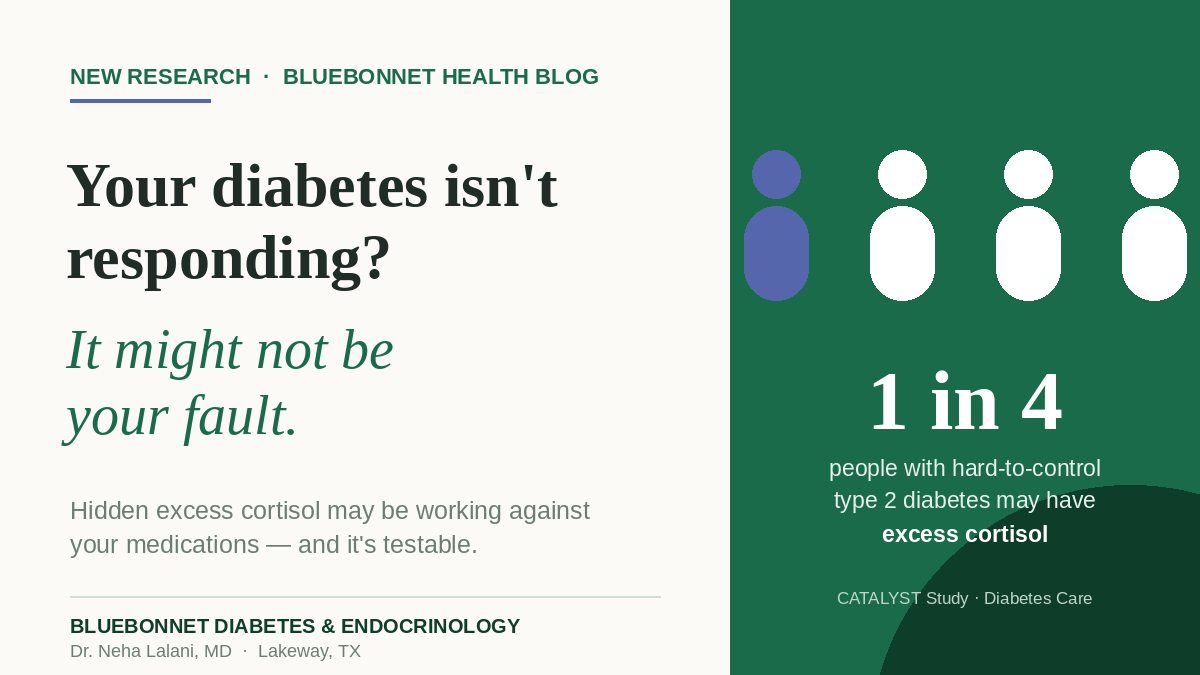
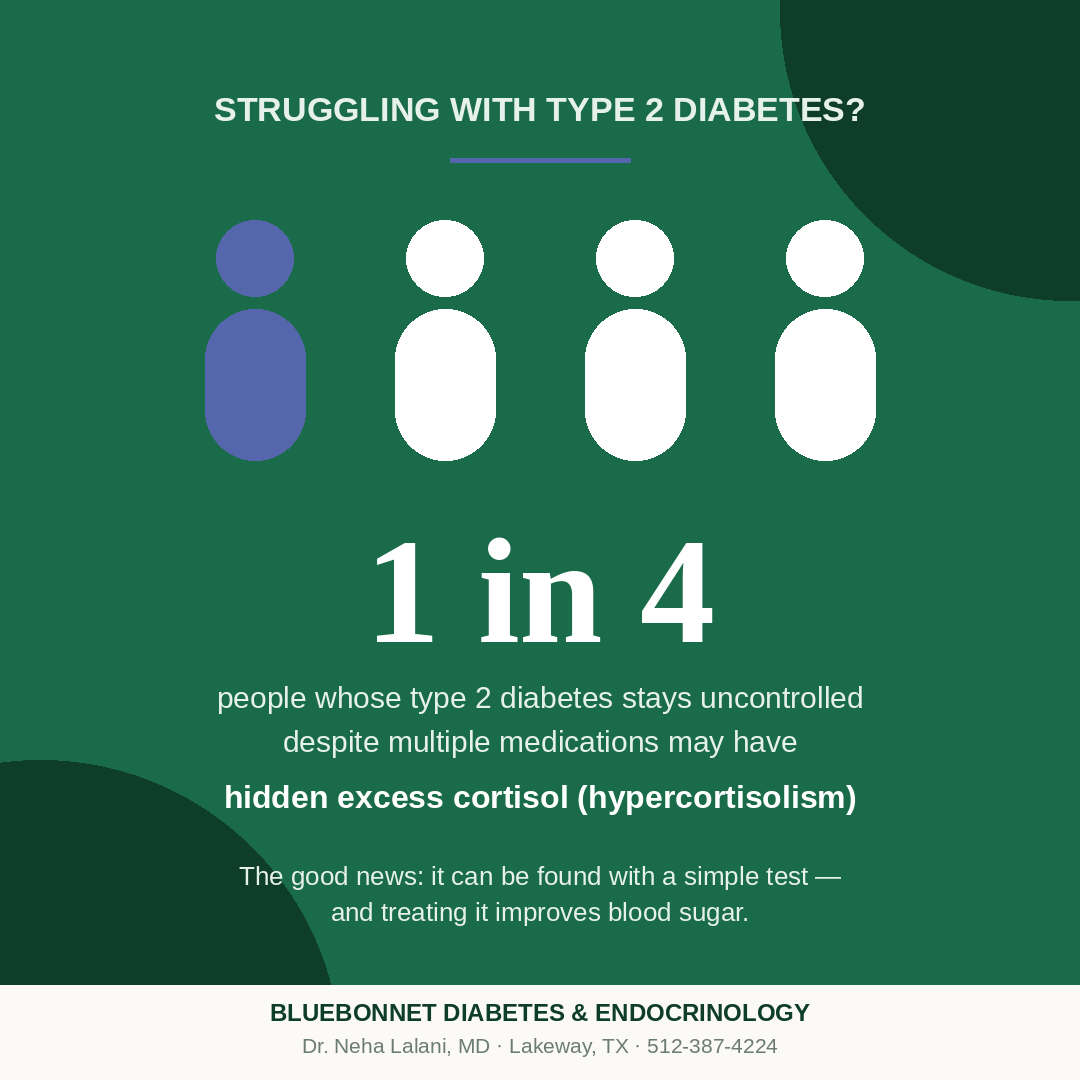
In 2024 and 2025, researchers published results from a trial called CATALYST, the largest study ever done on this question. They took over 1,000 patients with type 2 diabetes that stayed poorly controlled despite standard treatment and screened them for hypercortisolism, meaning too much cortisol, the body’s main stress hormone.
Let that sink in. These weren’t patients with any obvious signs of a cortisol problem. They looked like everyone else in the waiting room. They just needed more medications than expected, had more complications than expected, and weren’t getting better. The results, published in Diabetes Care, suggest that hidden cortisol excess is far more common in this group than most physicians, honestly including endocrinologists, would have guessed a few years ago. In patients who also needed three or more blood pressure medications, the rate was closer to one in three.
Hypercortisolism and type 2 diabetes: why cortisol matters
Cortisol’s job, among other things, is to raise blood sugar. That’s by design; it’s part of how your body responds to stress. But when cortisol runs high around the clock, it works directly against every diabetes medication you take. It pushes glucose up, promotes weight gain around the middle, raises blood pressure, and makes your body less responsive to insulin.
So you can be doing everything right and still lose ground, because you’re treating the downstream problem while the upstream one goes unaddressed.
Does treating it actually help?
This is the part of CATALYST I find most compelling. In the second phase, patients who screened positive were treated with a cortisol-blocking medication or placebo for six months. The treated group saw their A1c fall by more than a full percentage point compared to placebo. For context, that’s the kind of improvement we hope for when adding an entirely new diabetes drug. And it happened even though about half the treated patients were able to reduce their other diabetes medications during the study. They lost weight too.
There was a follow-up analysis presented at the ADA Scientific Sessions this June that I think deserves more attention than it’s gotten: the benefit held whether or not patients had already been on GLP-1 medications. I mention this because I meet a lot of people who assume that if semaglutide or tirzepatide didn’t get them to goal, nothing will. Sometimes the reason a GLP-1 underperforms is that cortisol was fighting it the whole time.
Who should think about getting screened
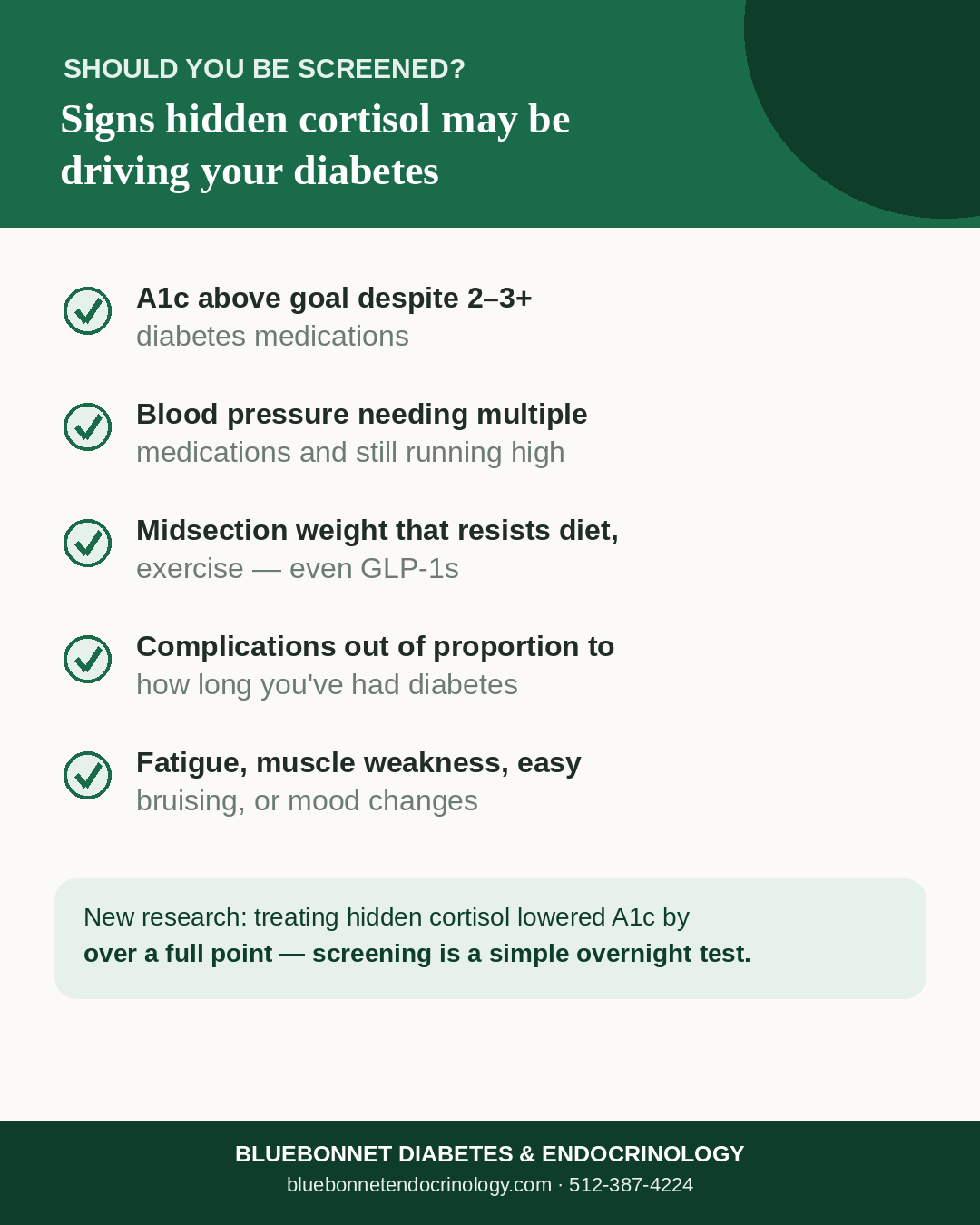
I’m not suggesting everyone with type 2 diabetes needs a cortisol workup. But based on this research, I’d want to check for hypercortisolism in patients who fit a certain picture:
- An A1c that stays above goal despite two, three, or more diabetes medications
- Blood pressure requiring multiple medications and still running high
- Weight concentrated around the midsection that hasn’t responded to real effort, including GLP-1 therapy
- Complications that seem out of proportion to how long you’ve had diabetes
- Fatigue, muscle weakness, easy bruising, or mood changes on top of everything else
The screening itself is simple and, frankly, anticlimactic. The test used in CATALYST is an overnight dexamethasone suppression test: you take one low-dose tablet at bedtime and have blood drawn the next morning. If the result is abnormal, we dig deeper. In a portion of patients, the trail leads to a small benign growth on an adrenal gland that has been quietly overproducing cortisol for years.
My honest take
Most primary care visits are fifteen minutes. There is rarely time to ask why someone’s diabetes is resistant; the practical move is to add another medication and recheck in three months. I understand it, and sometimes it’s the right call.
But CATALYST tells us that for a meaningful subset of patients, the answer to “why isn’t this working?” is sitting one layer deeper, in the endocrine system. Finding it changes everything about the treatment plan. This kind of detective work is, in my opinion, the actual point of seeing an endocrinologist, and it’s some of the most satisfying medicine I get to practice.
If your diabetes has been difficult to control despite genuine effort, it’s worth having someone look past the glucose numbers to the hormones underneath them. You may not have a cortisol problem. But you deserve to know.
I’m Dr. Neha Lalani, and I see patients at Bluebonnet Diabetes & Endocrinology in Lakeway, with telemedicine visits available across Texas. No referral needed. Call us at 512-387-4224 or request an appointment online.
If you’re on a GLP-1 and not seeing the results you hoped for, you may also want to read our related posts on oral GLP-1 medications here on the blog.
This article is for educational purposes and isn’t a substitute for personalized medical advice. Screening and treatment decisions should always be made with your physician.