For years, patients have asked us the same question: “Is there a pill version of Ozempic or Wegovy?” Until recently, the answer was mostly no. But 2026 has changed the landscape significantly. There are now three FDA-approved oral GLP-1 medications available in the United States.
Oral GLP-1 pills in 2026 have changed everything for patients who’ve avoided GLP-1 therapy because of injections. There are now three FDA-approved options — and they’re very different from each other.
What Are GLP-1 Medications — and How Do They Work?
GLP-1 (glucagon-like peptide-1) is a hormone your body produces naturally after you eat. It works on several fronts at once:
- Signals the pancreas to release insulin when blood sugar rises
- Slows stomach emptying, which can help reduce appetite
- Sends satiety signals to the brain, reducing food intake
- Suppresses glucagon, the hormone that tells your liver to release stored sugar
GLP-1 receptor agonist medications are designed to mimic these effects, which is why they can be effective at both lowering blood sugar and supporting weight loss in appropriate candidates. Injectable versions (Ozempic, Wegovy, Mounjaro, Zepbound) have been extensively studied. The three options below deliver GLP-1 therapy in a once-daily pill. Whether any of these medications is right for you depends on your individual medical history, diagnosis, and goals — something we evaluate on a patient-by-patient basis.
Option 1: The Oral Semaglutide Family — From Rybelsus to the Ozempic Pill
Approved for: Type 2 diabetes + reducing the risk of major adverse cardiovascular events in adults with type 2 diabetes at elevated cardiovascular risk
Background: Rybelsus (2019–2026)
Rybelsus was the first oral GLP-1 pill, approved in 2019 at doses of 7 mg and 14 mg. Results from the PIONEER clinical trial program at the maximum approved dose (14 mg) showed, on average:
- A1C reduction: ~1.0–1.4%
- Weight loss: ~3–4% of body weight (~3–5 kg / 6–11 lbs)
These are trial averages; individual results varied. Weight loss was a secondary benefit, not the primary indication.
Rybelsus came with strict dosing requirements, because semaglutide is a peptide that stomach acid can break down:
- Had to be taken first thing in the morning on a completely empty stomach
- No more than 4 oz of plain water
- A 30-minute wait required before eating, drinking anything else, or taking other medications
For many patients, this routine posed a real adherence challenge.
What Changed: The Ozempic Pill (Available May 2026)
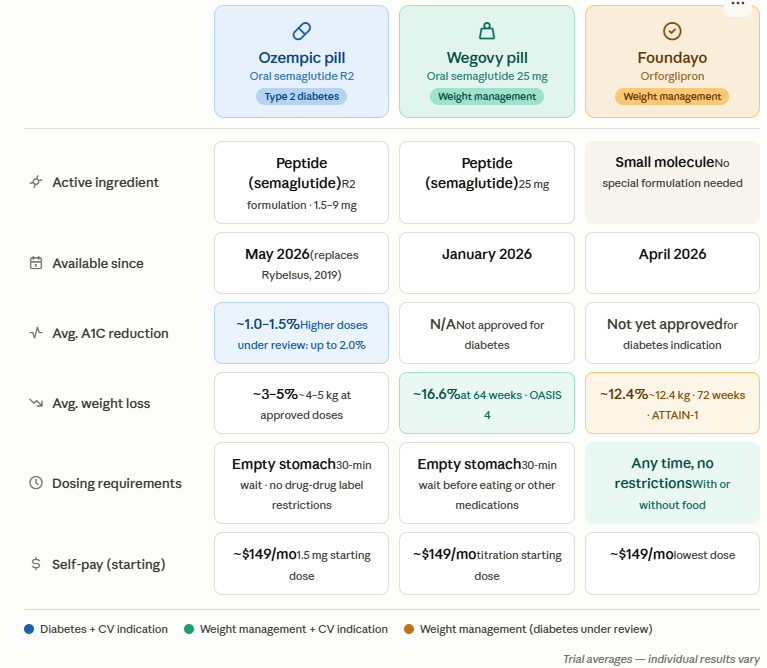
As of May 4, 2026, Rybelsus has been retired in the US. Novo Nordisk replaced it with a next-generation formulation — the Ozempic pill (oral semaglutide R2) — now available at pharmacies nationwide.
Key formulation improvements include:
- Improved bioavailability — the R2 formulation offers more consistent absorption than the original
- Smaller pill size — easier to swallow for most patients
- No drug-drug interaction restrictions in the label — unlike Rybelsus, the Ozempic pill label does not require delaying other medications. Patients should still discuss all concurrent medications with their provider, as individual drug interactions may still apply
- Lower doses, equivalent effect — the 9 mg Ozempic pill is bioequivalent to the 14 mg Rybelsus
Note: An empty stomach and a brief waiting period before eating are still required.
At equivalent doses, clinical outcomes are similar to Rybelsus (trial averages):
- A1C reduction: ~1.0–1.5%
- Weight loss: ~3–5% of body weight (~4–5 kg)
Self-pay pricing (subject to change; verify with your pharmacy):
- 1.5 mg (starting dose): ~$149/month
- 4 mg: ~$199/month
- 9 mg (maximum approved dose): ~$299/month
- Patients with commercial insurance may be eligible for reduced copays — your pharmacist or our office can help verify coverage
On the Horizon: Higher-Dose Oral Semaglutide for Diabetes
The PIONEER PLUS phase 3 trial, published in The Lancet, evaluated oral semaglutide at 25 mg and 50 mg daily in adults with type 2 diabetes — doses not yet FDA-approved for diabetes. Trial averages showed:
| Dose | A1C Reduction | Average Weight Loss |
| 14 mg (current max) | −1.5% | 4.4 kg |
| 25 mg (investigational) | −1.8% | 6.7 kg |
| 50 mg (investigational) | −2.0% | 8.0 kg |
A diabetes indication for these higher doses has not yet been submitted to or approved by the FDA. These doses are not currently available for diabetes treatment and are referenced here for informational context only.
A note on transitioning from Rybelsus: If you are currently taking Rybelsus, do not discontinue or switch medications without consulting your provider. Your provider will determine the appropriate transition plan based on your individual clinical situation.
Option 2: Wegovy Pill (Oral Semaglutide 25 mg)
Approved for: Chronic weight management in adults with obesity, or overweight with at least one weight-related comorbidity; also indicated to reduce the risk of major adverse cardiovascular events in adults with established cardiovascular disease and overweight or obesity Available since: January 2026
The Wegovy pill is the first oral GLP-1 approved specifically for weight management. It uses the same active ingredient as the Ozempic pill, but at a higher dose (25 mg) and for a different indication. These are not interchangeable — the appropriate medication and dose must be determined by your provider.
Results from the OASIS 4 clinical trial (trial averages):
- Average weight loss: ~16.6% of body weight over 64 weeks in patients who remained on treatment (vs. ~3% with placebo)
- Trial participants also received lifestyle intervention; results in routine clinical practice may differ
Key things to know:
- The cardiovascular risk reduction indication applies specifically to adults with established cardiovascular disease — not to all patients with overweight or obesity
- Dosing still requires an empty stomach and 30-minute wait each morning
- Dose escalation begins at 1.5 mg and titrates up to 25 mg over several months; this process is managed under clinical supervision
Best suited for (as determined by your provider): Adults with obesity, or overweight with a qualifying comorbidity, who are appropriate candidates for pharmacotherapy and can reliably follow the morning dosing routine.
Option 3: Foundayo (Orforglipron)
Approved for: Chronic weight management in adults with obesity, or overweight with at least one weight-related comorbidity Available since: April 2026
Foundayo works differently at a molecular level. Orforglipron is a small molecule rather than a peptide, so it survives digestion without special formulation. Practically, this means:
- Can be taken at any time of day
- No food or water restrictions
- No waiting period required
Results from the ATTAIN-1 trial, published in The New England Journal of Medicine (trial averages at highest dose over 72 weeks):
- Weight loss: ~12.4% of body weight (~12.4 kg / ~27 lbs)
- Statistically significant improvements in blood pressure, cholesterol, and waist circumference were also observed
Regarding diabetes data: Head-to-head trial data comparing orforglipron to oral semaglutide in adults with type 2 diabetes has been published, showing promising A1C reductions. However, Foundayo is not currently FDA-approved for type 2 diabetes. A diabetes indication is under regulatory review and has not yet been approved. Patients with type 2 diabetes should not use Foundayo as a diabetes treatment until and unless a diabetes indication is approved.
Self-pay pricing (subject to change): Starting at approximately $149/month for the lowest dose, with potential savings through manufacturer programs. Verify current pricing and eligibility with your pharmacy or our office.
Best suited for (as determined by your provider): Adults who are appropriate candidates for weight management pharmacotherapy and whose lifestyle or medication schedule makes flexible dosing an important factor in adherence.
Side Effects and Safety Considerations of Oral GLP-1 Pills
All three oral GLP-1 pills share the GLP-1 class side effect profile. Most common side effects:
- Nausea
- Vomiting
- Constipation or diarrhea
- Symptoms are most frequent during dose escalation and often improve with time
Important safety information (this is not a complete list — a full review of your medical history is required before prescribing):
These medications are contraindicated in patients with:
- Personal or family history of medullary thyroid carcinoma (MTC)
- Multiple Endocrine Neoplasia syndrome type 2 (MEN 2)
- Known hypersensitivity to the active ingredient or any excipient
They should be used with caution or may not be appropriate in patients with:
- History of pancreatitis
- Severe gastrointestinal disease
- Diabetic retinopathy (semaglutide — rapid glucose lowering may transiently worsen retinopathy)
- Significant renal impairment
- Pregnancy or intent to become pregnant — these medications should be discontinued prior to conception
This list is not exhaustive. A thorough medical evaluation is required to determine whether any of these medications is appropriate for you.
Which Oral GLP-1 Pill Might Be Right for You?
Choosing the right oral GLP-1 pill depends on many factors, including:
- Your primary diagnosis (type 2 diabetes vs. obesity/overweight)
- Cardiovascular history and risk profile
- Other medications you take
- Insurance coverage and out-of-pocket costs
- Ability to adhere to dosing requirements
- Your A1C, weight, and other clinical goals
This article is intended to give you a starting point — not to substitute for an individualized clinical evaluation. At Bluebonnet Diabetes & Endocrinology, we assess each patient’s full medical picture before recommending any GLP-1 therapy.
To schedule a consultation: Call us at 512-387-4224 or visit https://bluebonnetendocrinology.com/#appointment
This article is for general educational purposes only and does not constitute medical advice, a diagnosis, or a treatment recommendation. It is not a substitute for evaluation by a qualified healthcare provider. All clinical trial data cited represents study averages from controlled research settings; individual patient outcomes will vary and cannot be predicted in advance. Drug availability, pricing, and FDA approval status are subject to change. Medication selection, dosing, and monitoring must be individualized and supervised by a licensed clinician. Information current as of June 2026.