
Following a decade-long global consensus process, polycystic ovary syndrome (PCOS) has been officially renamed polyendocrine metabolic ovarian syndrome (PMOS). The renaming was published in The Lancet and endorsed by the Endocrine Society and 55 other leading academic, clinical, and patient organizations worldwide.
For nearly a century, this condition was named after what a surgeon noticed on an ovary — some small sac-like structures that looked like cysts. The name stuck. But science moved on, and the name did not.
“Polycystic ovary syndrome” was always a misnomer. The structures on ultrasound are not pathological cysts — they are arrested follicles. And critically, you do not need to have them at all to have this condition. More importantly, the name reduced a complex, multisystem hormonal disorder to a perceived problem with the ovaries, causing patients and even clinicians to miss the bigger picture.
Research showed the old name contributed to diagnostic delays affecting up to 70% of those with the condition, fragmented care, stigma, and under-investment in research. After consulting over 22,000 experts, patients, clinicians, and advocates from every world region over eleven years, the global consensus was clear: change the name. The process and rationale are detailed in full in the original Lancet publication .
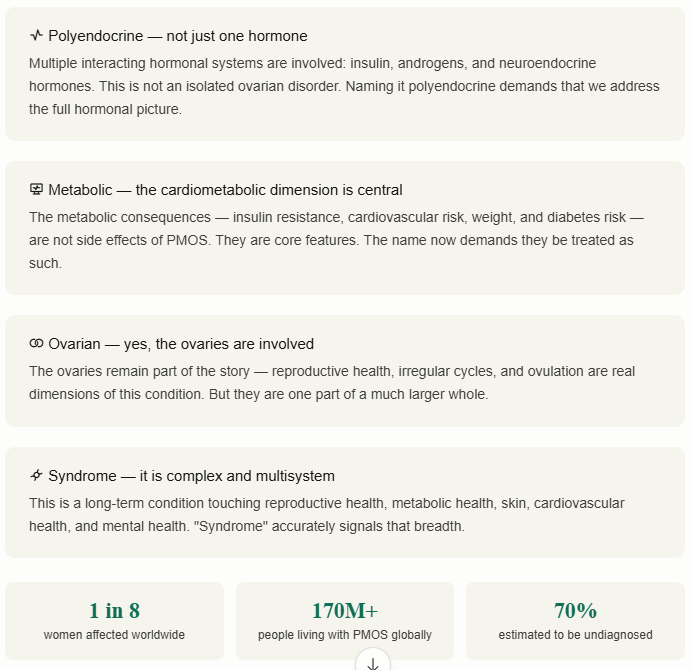
What “PMOS” tells us that “PCOS” never did
Every word in the new name carries meaning:
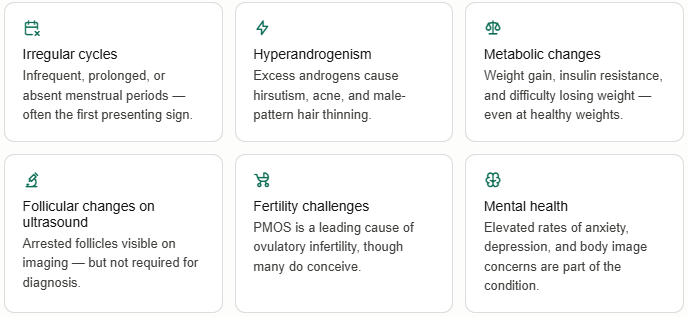
Symptoms: same condition, clearer lens
The symptoms have not changed — our understanding of them has. PMOS is a multisystem disorder and its symptoms span several body systems accordingly.
Diagnosis: the Rotterdam criteria remain
Diagnosis still requires at least two of three criteria: irregular or absent periods, clinical or biochemical evidence of elevated androgens, and follicular changes on ovarian ultrasound. Importantly, the third criterion — the ultrasound finding — is not required. Many people with PMOS never see “cysts” on imaging, which made the old name even more confusing.
A full evaluation also rules out conditions with overlapping presentations: thyroid disorders, hyperprolactinemia, and adrenal disorders. As with all endocrine conditions, thorough workup matters.
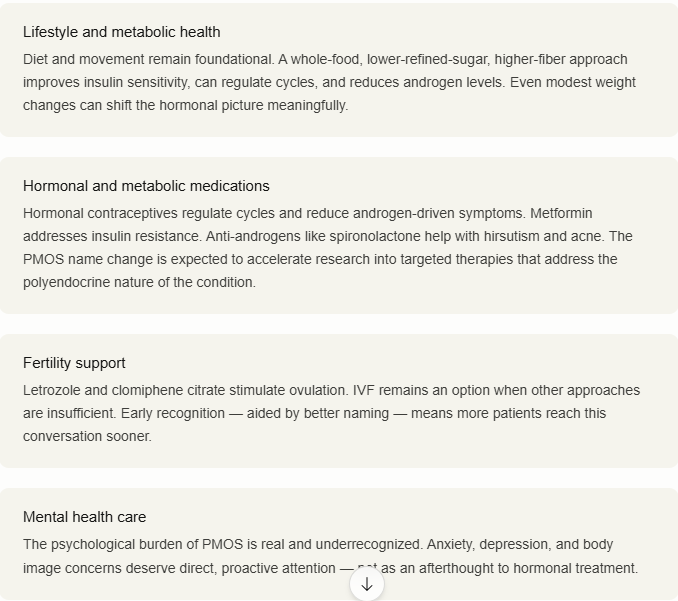
Managing PMOS: a whole-person approach
There is no cure, but there is excellent management. Because PMOS is now explicitly recognized as a metabolic and hormonal condition — not just a reproductive one — treatment increasingly addresses all of these dimensions together.
Long-term health monitoring
→Type 2 diabetes: Insulin resistance means significantly elevated risk. Regular glucose monitoring and proactive metabolic management are essential.
→Cardiovascular disease: Dyslipidemia, hypertension, and increased cardiovascular risk require ongoing monitoring and heart-healthy habits.
→Endometrial health: Irregular cycles can allow the uterine lining to build up. Maintaining regular periods — through hormonal management — reduces cancer risk.
→Sleep apnea: More common in PMOS, particularly in the presence of excess weight. Often underdiagnosed in women.
What the name change means for you
If you have a PCOS diagnosis, nothing about your condition has changed — but everything about how it should be understood and treated is shifting. A three-year international transition period is now underway, with clinical guidelines, medical education, and disease classification systems all being updated to reflect the new name.
The name change should mean fewer delayed diagnoses, less stigma, more comprehensive care that addresses metabolic health alongside reproductive health, and stronger research momentum. The Endocrine Society’s announcement includes multilingual resources and a transition roadmap for patients and clinicians alike.
Expert PMOS care in Lakeway & across Texas
Dr. Neha Lalani at Bluebonnet Diabetes & Endocrinology provides comprehensive, personalized care for PMOS — addressing hormonal, metabolic, and reproductive health together. New patients seen within one week. Telemedicine available statewide.
📞 (512) 387-4224 · 3 Lakeway Centre CT, Suite 220, Lakeway, TX 78734
Sources
- Teede et al. — Polyendocrine metabolic ovarian syndrome, the new name for polycystic ovary syndrome: a multistep global consensus process. The Lancet, May 12, 2026.
- Endocrine Society — Polyendocrine Metabolic Ovarian Syndrome: new name to improve diagnosis and care. May 2026.