Preventing Heart Disease Starts with Hormones: The Endocrinologist’s Role in Cardiovascular Health

February is American Heart Month. This is a great opportunity to explore ways to better care for our hearts. Heart disease remains the leading cause of death worldwide. While cardiologists treat established cardiovascular disease, endocrinologists play a crucial role in preventing heart disease by addressing the hormonal and metabolic drivers that underlie most cardiovascular events. Decades of high-quality research now show that early intervention in metabolic and hormonal health can dramatically change cardiovascular outcomes.
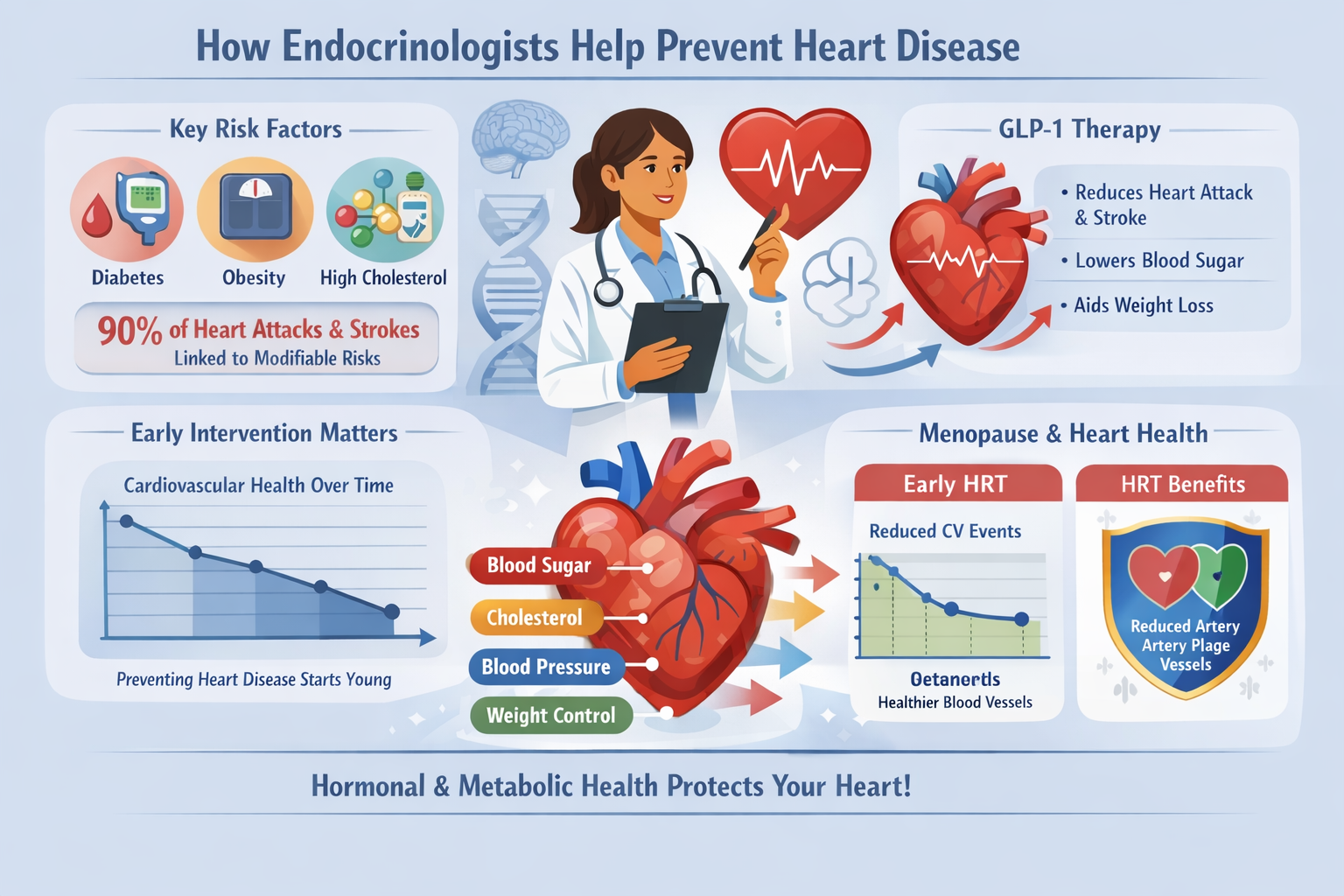
Metabolic Health Is Central to Cardiovascular Risk
Landmark global studies have demonstrated that the majority of heart attacks and strokes are driven by modifiable metabolic and lifestyle risk factors.
The INTERHEART study, which included participants from 52 countries, identified nine modifiable risk factors—including diabetes, abdominal obesity, dyslipidemia, hypertension, and smoking—that together accounted for over 90% of the risk of a first myocardial infarction¹.
Similarly, the INTERSTROKE study found that ten largely modifiable risk factors, many of them metabolic, explained approximately 90% of the global risk of stroke².
These findings underscore a key point: heart disease prevention is largely metabolic disease prevention, an area where endocrinologists have deep expertise.
Cardiovascular Risk Begins Early—Often Decades Before Disease
A major longitudinal analysis published in the Journal of the American College of Cardiology demonstrated that cardiovascular health steadily declines from young adulthood into midlife, driven by worsening blood pressure, cholesterol, glucose, and body weight³. Subclinical metabolic dysfunction during early adulthood significantly increases the likelihood of later cardiovascular disease.
Endocrinologists are uniquely positioned to identify and treat these abnormalities early—often before symptoms or irreversible vascular damage occur.
GLP-1 Receptor Agonists: Endocrine Therapies with Proven Heart Benefits
Modern endocrine therapies now directly reduce cardiovascular events. Cardiovascular outcome trials (CVOTs) consistently show that GLP-1 receptor agonists (GLP-1 RAs) reduce major adverse cardiovascular events, including heart attack, stroke, and cardiovascular death⁴.
A recent review in the Journal of Endocrinology confirms that these benefits extend beyond glucose lowering and are likely mediated by improvements in:
• Body weight
• Blood pressure
• Postprandial lipids
• Systemic inflammation
• Possibly direct effects on the heart and vasculature⁵
These therapies, commonly prescribed by endocrinologists, illustrate how hormone-based treatments can modify cardiovascular risk at a biological level.
Weight Loss and Cardiovascular Risk Reduction
Even modest weight loss has profound cardiometabolic effects. A classic study published in The Journal of Clinical Endocrinology & Metabolism demonstrated that 5–10% weight loss in individuals with type 2 diabetes led to:
• Improved insulin sensitivity
• Reduced blood pressure
• Lower LDL cholesterol
• Better glycemic control⁶
These improvements translate into meaningful reductions in long-term cardiovascular risk, reinforcing the importance of endocrine-guided weight management.
Thyroid Function and Cardiovascular Health
In addition to metabolic drivers like diabetes and obesity, thyroid hormones play an essential role in regulating cardiovascular function. Thyroid hormone impacts heart rate, myocardial contractility, lipid metabolism, and vascular resistance, all of which influence heart disease risk⁷.
Subclinical hypothyroidism—defined as elevated TSH with normal T3/T4—is common (3–10% prevalence) and is associated with higher cardiovascular risk compared with normal thyroid function⁸.
Several large cohort analyses show:
• In studies of >55,000 adults, individuals with TSH ≥10 mIU/L had nearly a 1.9-fold higher risk of coronary heart disease (CHD) events (38.4 vs 20.3 per 1,000 person-years) and a 1.58-fold higher CHD mortality risk compared with euthyroid participants⁹.
• Meta-analyses of >555,000 participants found that subclinical hypothyroidism was associated with a 33% higher risk of cardiovascular disease (RR 1.33) and a 20% higher risk of all-cause mortality compared with euthyroid individuals⁹.
• Another pooled analysis reported that subclinical hypothyroidism was linked to increased odds of CHD (summary OR ~1.65) across observational studies¹⁰.
These data show that even mild thyroid dysfunction, when persistent and untreated, elevates risk for major cardiovascular events—reinforcing the importance of endocrine screening and management.
Menopause, Estrogen, and the Timing Hypothesis
Hormonal transitions also influence cardiovascular risk, particularly in women. The Timing Hypothesis proposes that the cardiovascular effects of menopausal hormone therapy (MHT) depend on when therapy is initiated relative to menopause¹¹.
Key supporting evidence includes:
• The Danish Osteoporosis Study (DOPS) showed that women who initiated hormone therapy shortly after menopause experienced a ~50% reduction in cardiovascular events over 10 years, with sustained benefit over extended follow-up¹².
• The ELITE trial demonstrated that estradiol slowed atherosclerosis progression only when started within six years of menopause, but not when initiated later¹³.
While hormone therapy is not prescribed solely for cardiovascular prevention, these studies highlight the importance of individualized, timing-sensitive endocrine care.
Why Endocrinologists Are Central to Heart Disease Prevention
Taken together, these data show that endocrinologists help prevent heart disease by:
• Identifying metabolic dysfunction early, including insulin resistance and dyslipidemia
• Managing diabetes and obesity with therapies that reduce cardiovascular events
• Optimizing hormonal health, including thyroid and menopausal care
• Addressing root causes, not just cardiovascular symptoms
Heart disease rarely develops suddenly. It evolves silently through metabolic and hormonal pathways over decades—and endocrinologists address those pathways at their source.
Conclusion
Cardiovascular disease prevention extends far beyond the heart itself. Hormones and metabolism shape cardiovascular risk long before clinical disease emerges. By treating diabetes, obesity, lipid disorders, and hormonal imbalances with evidence-based strategies, endocrinologists play a powerful and often under-recognized role in protecting the heart before disease begins.
References
- Yusuf S, et al. Effect of potentially modifiable risk factors associated with myocardial infarction in 52 countries (INTERHEART study). Lancet. 2004.
- O’Donnell MJ, et al. Global and regional effects of potentially modifiable risk factors associated with acute stroke (INTERSTROKE). Lancet. 2016.
- Allen NB, et al. Long-term cardiovascular risk trajectories from young adulthood. J Am Coll Cardiol. 2021.
- Marso SP, et al. Cardiovascular outcomes with GLP-1 receptor agonists. N Engl J Med. 2016–2023.
- GLP-1 receptor agonist–based therapies and cardiovascular outcomes. Journal of Endocrinology. 2024.
- Wing RR, et al. Benefits of modest weight loss in type 2 diabetes. J Clin Endocrinol Metab. 2011.
- Klein I, Danzi S. Thyroid disease and the heart. Circulation. 2007.
- Ning Y, et al. Subclinical hypothyroidism and cardiovascular outcomes. Front Endocrinol. 2020.
- Rodondi N, et al. Subclinical hypothyroidism and the risk of coronary heart disease and mortality. JAMA. 2010.
- Udovcic M, et al. Hypothyroidism and the heart. Methodist DeBakey Cardiovasc J. 2017.
- Harman SM, et al. Timing and duration of menopausal hormone treatment may affect cardiovascular outcomes. Menopause. 2011.
- Schierbeck LL, et al. Effect of hormone replacement therapy on cardiovascular events in recently postmenopausal women (DOPS). BMJ. 2012.
- Hodis HN, et al. Effects of estradiol on progression of subclinical atherosclerosis (ELITE Trial). N Engl J Med. 2016.
Take the Next Step
Concerned about your heart health or cardiometabolic risk? Schedule an appointment with Dr. Neha Lalani to take a proactive, personalized approach to preventing heart disease through metabolic and hormonal care.
Take the Next Step
Interested in a proactive, personalized approach to your health? Dr. Lalani at Bluebonnet Diabetes & Endocrinology is here to help.